Nexaro Pest RemovalNexaro Pest Removal

Subterranean Termite Treatment Albuquerque

Subterranean termite treatment in Bernalillo County requires defensive techniques tailored to high-desert soil composition. In river-adjacent zones like North Valley and South Valley, high water tables and alluvial…
Get My Free Estimate →(505) 207-1870
Subterranean Termite Treatment in Albuquerque, NM
Quick answer
  • What is included: Full exterior foundation trenching, slab expansion joint micro-drilling, non-repellent liquid termiticide application, and continuous crawlspace inspection.
  • Turnaround time: On-site structural assessments take 45 to 60 minutes; complete perimeter installations typically take 4 to 8 hours depending on linear footage.
  • Standard cost: Baseline localized defensive barrier treatments start at the $200 minimum, with comprehensive home perimeter barriers ranging from $950 to $2,800 based on square footage.
  • Target pests treated: Desert subterranean termites (Reticulitermes and Heterotermes aureus) and associated wood-destroying subterranean colony networks.
  • Scheduling process: Concrete-slab or crawlspace evaluations are arranged directly by phone at (505) 207-1870 with an on-site technician confirming final linear measurements.

Subterranean termite treatment in Bernalillo County requires defensive techniques tailored to high-desert soil composition. In river-adjacent zones like North Valley and South Valley, high water tables and alluvial silt create ideal subterranean moisture paths. Conversely, properties across the Westside, Taylor Ranch, and Paradise Hills sit on hard-packed caliche and gravel, where subterranean termites track narrow structural expansion cracks beneath monolithic concrete slabs. The desert subterranean termite (Heterotermes aureus) operates through deep underground mud tubes, bypassing conventional surface bug sprays entirely. An unfortified structural perimeter allows workers to hollow out structural studs, baseboards, and sill plates from the inside out before external visual signs emerge.

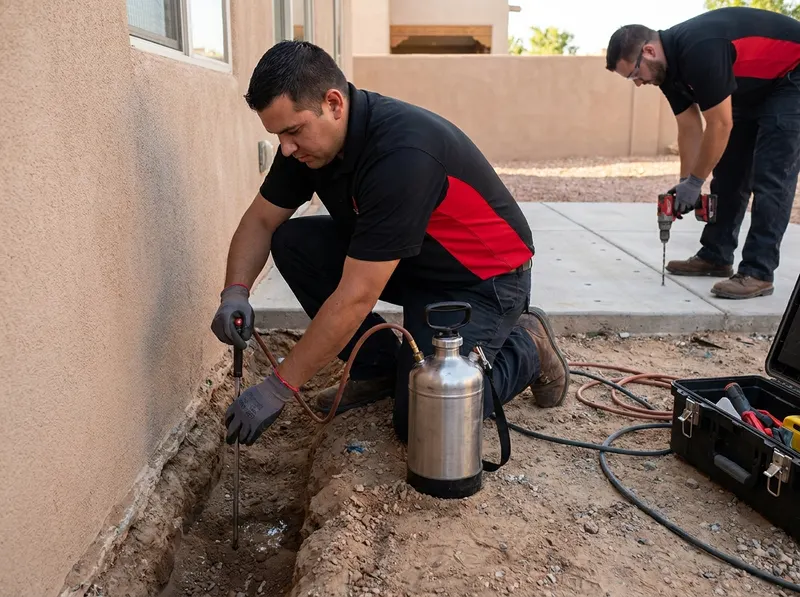
Protective intervention relies on continuous liquid non-repellent applications or external subterranean monitoring bait arrays. A liquid perimeter barrier involves opening a trench 6 inches deep by 6 inches wide along external stem walls and rod-injecting liquid termiticide at a standard rate of 4 gallons per 10 linear feet. In locations where continuous concrete or adobe footers abut the structure, common in historic Nob Hill bungalows, Old Town footings, or Huning Castle estates, the technician drills 0.5-inch access holes spaced roughly 12 inches apart through the slab to establish an unbroken treatment line. Non-repellent active ingredients do not deter workers on contact; instead, foraging termites track the carrier compound back to the central subterranean queen, neutralizing the subterranean colony through social grooming transfer within 30 to 90 days.

Deciding between liquid perimeter barriers and subterranean bait stations depends on structural foundation architecture. Monolithic concrete slab foundations in Bear Canyon or the Sandia Foothills benefit from continuous non-repellent liquid barriers because subterranean termites exploit internal plumbing penetrations hidden beneath floor tiles. Crawlspace foundations or structures bounded by protected native xeriscaping frequently opt for subterranean bait matrix stations placed every 10 to 15 feet around the drip line. While a liquid barrier provides immediate defensive saturation at the exact foundation interface, bait stations preserve extensive hardscape by monitoring underground termite activity through seasonal shifts. The trade-off is response time: liquid termiticide arrests subterranean access within weeks, whereas bait stations require ongoing quarterly checks to monitor consumption rates and replace wood attractants with chitin inhibitors.

Subterranean Termite Treatment cost in Albuquerque

Spot or localized defensive barrier treatment$200, $450
Standard slab home full perimeter trench & rod (1,500, 2,200 sq ft)$950, $1,650
Large home or stem-wall/crawlspace barrier (2,500, 3,500 sq ft)$1,700, $2,800
Commercial foundation or extensive concrete drill-and-treat$2,200, $4,500
Annual subterranean barrier renewal & inspection$200, $350

Every job gets a firm, written price after a free on-site visit.

Common questions

How much does subterranean termite treatment cost in Albuquerque?
Subterranean termite treatment in Albuquerque costs between $950 and $2,800 for a complete residential perimeter, with localized spot treatments starting at the $200 minimum charge. The final cost depends on foundation type, linear perimeter footage, and whether drilling through exterior concrete patios or brick pavers is required.
Are subterranean termite barrier treatments safe for household pets in Albuquerque?
Subterranean termite treatments in Albuquerque are placed below the surface of the soil or beneath structural concrete slabs, eliminating surface exposure for dogs and cats. Once the liquid trench is backfilled with native soil and the application has completely dried, pets can resume normal yard access.
How does Albuquerque's arid climate affect the durability of termite soil barriers?
High-desert ultraviolet radiation breaks down surface pesticides quickly, but subterranean termite treatments are injected 6 to 12 inches underground where soil temperatures remain stable. These subterranean non-repellent liquid barriers typically maintain defensive potency in Bernalillo County soil for 5 to 8 years without degrading.
How do technicians treat termites under concrete patios or driveways in Albuquerque?
Technicians use rotary hammer drills to create 0.5-inch holes spaced 12 inches apart through the exterior concrete slab along the foundation wall. Liquid termiticide is injected under low pressure directly into the underlying soil, after which each drill hole is sealed flush with hydraulic concrete patch matching the original surface.
What is the difference between subterranean termites and drywood termites in Albuquerque?
Subterranean termites nest underground and construct protective mud tubes to travel from moisture-bearing soil into structural timber, whereas drywood termites nest entirely inside wooden members without soil contact. Over 95% of structural termite infestations documented across Albuquerque and the Middle Rio Grande valley stem from subterranean species.
Helpful resources

Trusted references & local links

USA.gov, government & consumer helpBetter Business BureauFTC Consumer AdviceU.S. Small Business AdministrationReady.govU.S. EPAENERGY STARU.S. Dept. of EnergyConsumer.govU.S. Census BureauGoogle Maps, Albuquerque, NM

Get started today

Tell us about your subterranean termite treatment job in Albuquerque and we'll send a clear, written quote, usually the same day.

Get your free pest control services quote, Albuquerque

We only use your ZIP to check availability, no spam.