Active bed bug infestations cause severe sleep disruption, physiological distress, and secondary skin irritations. In Bernalillo County, infestations present unique remediation challenges due to regional architectural…
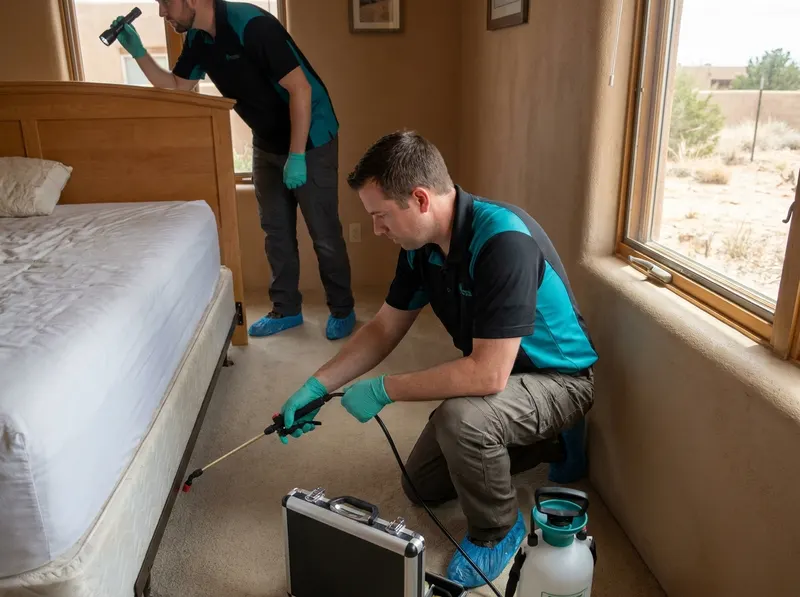
Active bed bug infestations cause severe sleep disruption, physiological distress, and secondary skin irritations. In Bernalillo County, infestations present unique remediation challenges due to regional architectural styles. Historic adobe properties in the North Valley and South Valley feature irregular interior wall surfaces, exposed vigas, and micro-fissures that provide deep physical harborage inaccessible to over-the-counter surface sprays. Modern stucco builds and slab-on-grade homes across Taylor Ranch, Ventana Ranch, and High Desert present expansion joints, electrical conduits, and drywall voids that bed bugs utilize to migrate between adjacent bedrooms. Store-bought pyrethroid foggers routinely fail because regional Cimex lectularius populations exhibit documented metabolic resistance; such aerosols trigger repellent reactions that drive nymphs deeper into subflooring and attic insulation.
Eradication strategy requires selecting between targeted multi-stage chemical remediation and whole-structure thermal remediation. Thermal heat treatment elevates ambient room temperatures to 122°F, 135°F for a sustained period of 3 to 6 hours, penetrating dense textiles, hollow furniture legs, and structural framing to denature bed bug proteins and dehydrate unhatched eggs in a single visit. The operational trade-off centers on preparation intensity and upfront investment: thermal heat requires removing heat-sensitive items (wax candles, aerosol cans, fine art, vinyl records) and commands higher equipment deployment costs. Conversely, targeted chemical programs rely on non-repellent insect growth regulators (IGRs) combined with desiccant dusts (such as amorphous silica gel) injected into wall voids; this alternative requires 2 to 3 sequential treatments spaced 14 days apart to interrupt the biological egg-hatch cycle. Homeowners with indoor pets or chemical sensitivities often prefer thermal application, as heat leaves zero synthetic chemical residues across living spaces.
Field deployment adheres to a numbered three-stage remediation protocol. Step 1: Technicians complete a diagnostic inspection using high-lumen optical equipment, searching headboards, box springs, picture frames, and carpet tack strips throughout homes from Nob Hill to Sandia Heights. Step 2: The physical knockdown phase deploys commercial HEPA vacuums to extract visible life stages, followed by targeted application of steam at 220°F directly to textile seams. Step 3: Void injection delivers long-lasting desiccant dust inside outlet covers, plumbing escutcheons, and structural perimeter gaps to neutralize migrating survivors. Structural exclusion sealing along perimeter baseboards eliminates harborages, preventing bed bugs from spreading across interior partition walls. Direct dispatch across Downtown Albuquerque, Bear Canyon, and the Westside is arranged via (505) 207-1870.
Every job gets a firm, written price after a free on-site visit.
Tell us about your bed bug control job in Albuquerque and we'll send a clear, written quote, usually the same day.
 Nexaro Pest Removal