Termite control in Albuquerque requires distinct strategies depending on foundation architecture and local desert soil types. In neighborhoods like Nob Hill, Downtown Albuquerque, and South Valley, historic residences…
Termite control in Albuquerque requires distinct strategies depending on foundation architecture and local desert soil types. In neighborhoods like Nob Hill, Downtown Albuquerque, and South Valley, historic residences frequently feature stone footings, brick foundations, or earthen adobe walls directly adjoining damp valley soils near the Rio Grande. Subterranean termites construct subterranean mud tubes through micro-fissures in aged mortar to access framing lumber. In newer developments across Ventana Ranch and Taylor Ranch on the Westside, construction relies almost exclusively on monolithic concrete slab-on-grade foundations. Here, termites breach structures through utility penetrations, bath traps, and perimeter expansion joints rather than external mud tunnels over stem walls.
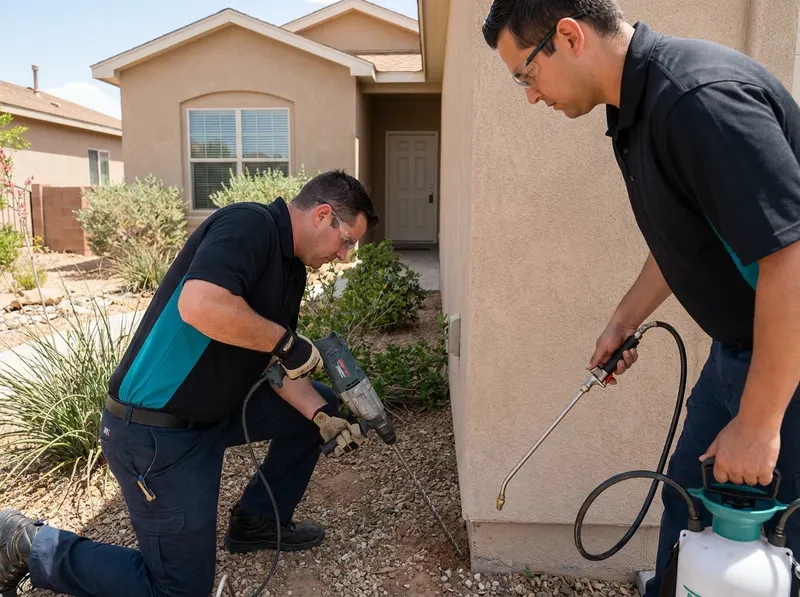
Treatment selection balances localized spot defense against complete perimeter continuous chemical barriers. Liquid non-repellent termiticides, such as fipronil formulations applied at 0.06% concentration, bind directly to Bernalillo County's sandy loam and caliche layers. Termites pass through this invisible zone without detection, transferring the active agent back to subterranean nesting galleries via social grooming. For homes with expansive concrete flatwork, such as driveways and wrap-around patios in Bear Canyon or High Desert, technicians core-drill 0.5-inch holes spaced 12 inches apart along the foundation perimeter to deposit liquid directly into sub-slab soil. Homes bordered by native xeriscaping, drip irrigation lines, or sandy slopes in Sandia Heights require horizontal trenching 6 inches wide by 6 inches deep to prevent chemical wash-out and protect non-target root systems.
1. Initial structural assessment: Technicians map out mud shelter tubes, probe structural mud sills, and record perimeter linear footage.
2. Soil trenching and rod injection: Operators dig a 6x6-inch perimeter trench along exterior footing walls and apply 4 gallons of finished termiticide dilution per 10 linear feet per foot of depth.
3. Concrete flatwork drilling: Solid exterior slabs are core-drilled at 12-inch intervals to inject product beneath driveways, walkways, and entry pads, followed by flush mortar patching.
4. Interior void treatment: Plumbing access traps behind tubs and utility conduits receive focused dry-foam termiticide to seal structural gaps without saturating subflooring.
5. Post-treatment verification: Monitoring stations are anchored at 10-foot perimeter intervals to track subterranean activity shifts without requiring ongoing pesticide reapplication.
Every job gets a firm, written price after a free on-site visit.
Tell us about your termite control job in Albuquerque and we'll send a clear, written quote, usually the same day.
 Nexaro Pest Removal