Properties positioned near the Rio Grande Nature Center State Park, North Valley acequias, and South Valley agricultural irrigation ditches face intense seasonal surges of floodwater mosquitoes alongside…
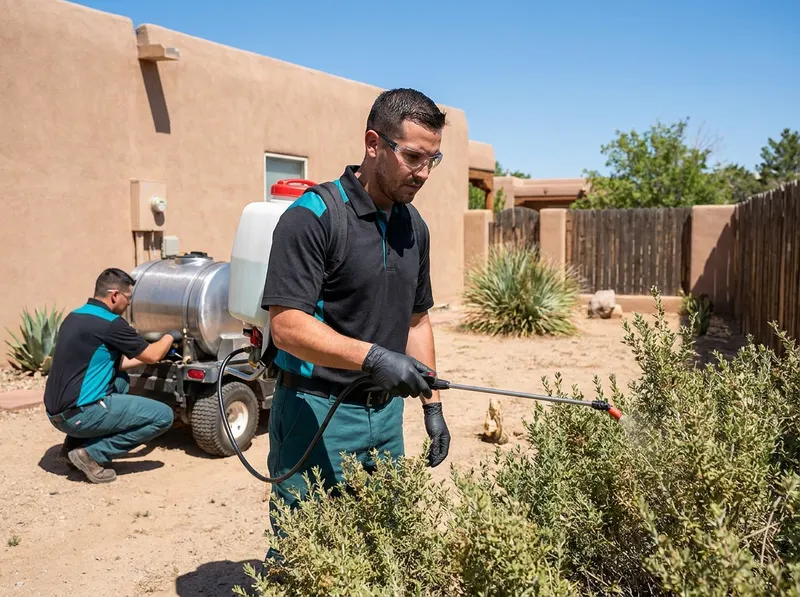
Properties positioned near the Rio Grande Nature Center State Park, North Valley acequias, and South Valley agricultural irrigation ditches face intense seasonal surges of floodwater mosquitoes alongside container-breeding species like Aedes aegypti. Dense brush, irrigated alfalfa fields, and residential drainage systems create sheltered microclimates that sustain reproduction despite ambient arid heat. Across elevated eastern zones like High Desert and Sandia Heights, drip-irrigation lines, decorative water features, and uncleaned roof channels provide isolated pockets where female mosquitoes deposit hundreds of eggs per cycle.
Professional high-desert intervention pairs mechanical exclusion with precise biological larvicides and targeted adulticide barrier sprays. Technicians apply Bacillus thuringiensis israelensis (Bti) granules directly into non-draining catchment basins, French drains, and shaded low spots, rupturing larval digestive systems within 24 hours without impacting native birds, honeybees, or residential vegetation. Shaded resting canopies, including the undersides of cottonwood trees, mature juniper hedges, adobe patio perimeters, and crawlspace vents, receive fine-droplet perimeter misting that binds to foliage and neutralizes adults upon contact.
Property size, shade density, and proximity to open ditch networks dictate operational scope. A standard quarter-acre lot in Taylor Ranch, Bear Canyon, or Ventana Ranch requires roughly 30 to 45 minutes of application time using focused backpack mist-blowers. Larger half-acre to full-acre parcels in the North Valley require comprehensive perimeter sweeps to build a resilient residual barrier against drift from neighboring unmanaged lots. Ongoing suppression relies on structural elimination of pooling water alongside recurring monthly barrier renewals through the October freeze line. Step 1: Technicians map all stagnant water pools, irrigation valves, and shaded plant canopies. Step 2: Biological larvicides are applied to captive water reservoirs. Step 3: Low-volume barrier misting is applied to perimeter fencing and dense ornamental brush. Homeowners can reach dispatch at (505) 207-1870 to schedule an on-site inspection.
Every job gets a firm, written price after a free on-site visit.
Tell us about your mosquito control job in Albuquerque and we'll send a clear, written quote, usually the same day.
 Nexaro Pest Removal