Rodent activity in Albuquerque follows sharp geographical patterns tied directly to the Rio Grande riparian corridor and the arid foothills of the Sandia Mountains. Along the irrigation ditches of the North Valley and…
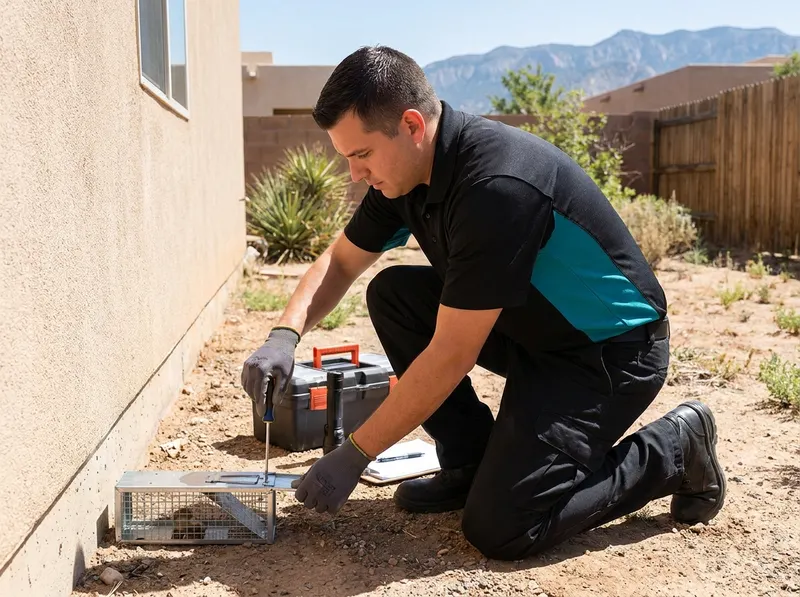
Rodent activity in Albuquerque follows sharp geographical patterns tied directly to the Rio Grande riparian corridor and the arid foothills of the Sandia Mountains. Along the irrigation ditches of the North Valley and South Valley, dense tree canopies support invasive roof rat populations that enter homes through open vigas, elastomeric roof gaps, and swamp cooler utility conduits. In the East Mesa, Bear Canyon, High Desert, and Sandia Heights, white-throated woodrats (pack rats) move from native cholla and juniper scrub directly into crawlspaces, subflooring, and garage utility chases. House mice compromise residential perimeters throughout urban centers like Nob Hill and Downtown Albuquerque, exploiting expansion joints and utility pipe penetrations beneath stucco finishes. Stucco weep screeds and foundation step-downs provide ready access points when settlement cracks widen beyond one-quarter of an inch.
Effective rodent eradication in an arid high-desert environment requires mechanical exclusion rather than simple chemical over-spraying. Over-the-counter bait stations fail because rodents ingest store-bought anticoagulants and perish inside dry adobe, block walls, or insulated crawlspaces, producing persistent structural odor issues that persist for weeks under desert temperatures. High-Desert Integrated Pest Management (IPM) prioritizes interior mechanical kill-traps paired with structural fortification using galvanized hardware cloth (19-gauge, 1/4-inch mesh), poly foam fill backed with stainless steel wool, and heavy-gauge copper mesh. This physical barrier approach prevents outdoor desert rodent populations from reinhabiting the space without applying broadcast interior poisons that pose exposure risks to indoor cats or domestic pets.
The initial phase of rodent control involves a precise, three-step containment sequence. Step 1: Technicians map every active transit run, gnaw mark, and grease rub along attic joists, crawlspace plates, and perimeter stem walls. Step 2: Interior snap-trap systems are placed directly on confirmed transit paths within isolated crawlspaces and attics, keeping trapping mechanisms out of living areas and away from domestic animals. Step 3: All external entry vectors are mechanically sealed. Exterior tamper-resistant rodenticide stations are secured along external foundation walls only when high outdoor population pressures in ditch banks or native arroyos demand long-term suppression. The trade-off between exterior trapping and structural exclusion is clear: exterior baiting lowers localized outdoor breeding counts, but physical structural sealing remains the only measure that guarantees long-term interior protection across Westside and Taylor Ranch neighborhoods.
Every job gets a firm, written price after a free on-site visit.
Tell us about your rodent control job in Albuquerque and we'll send a clear, written quote, usually the same day.
 Nexaro Pest Removal